
A conversation on mentorship at EF
/)
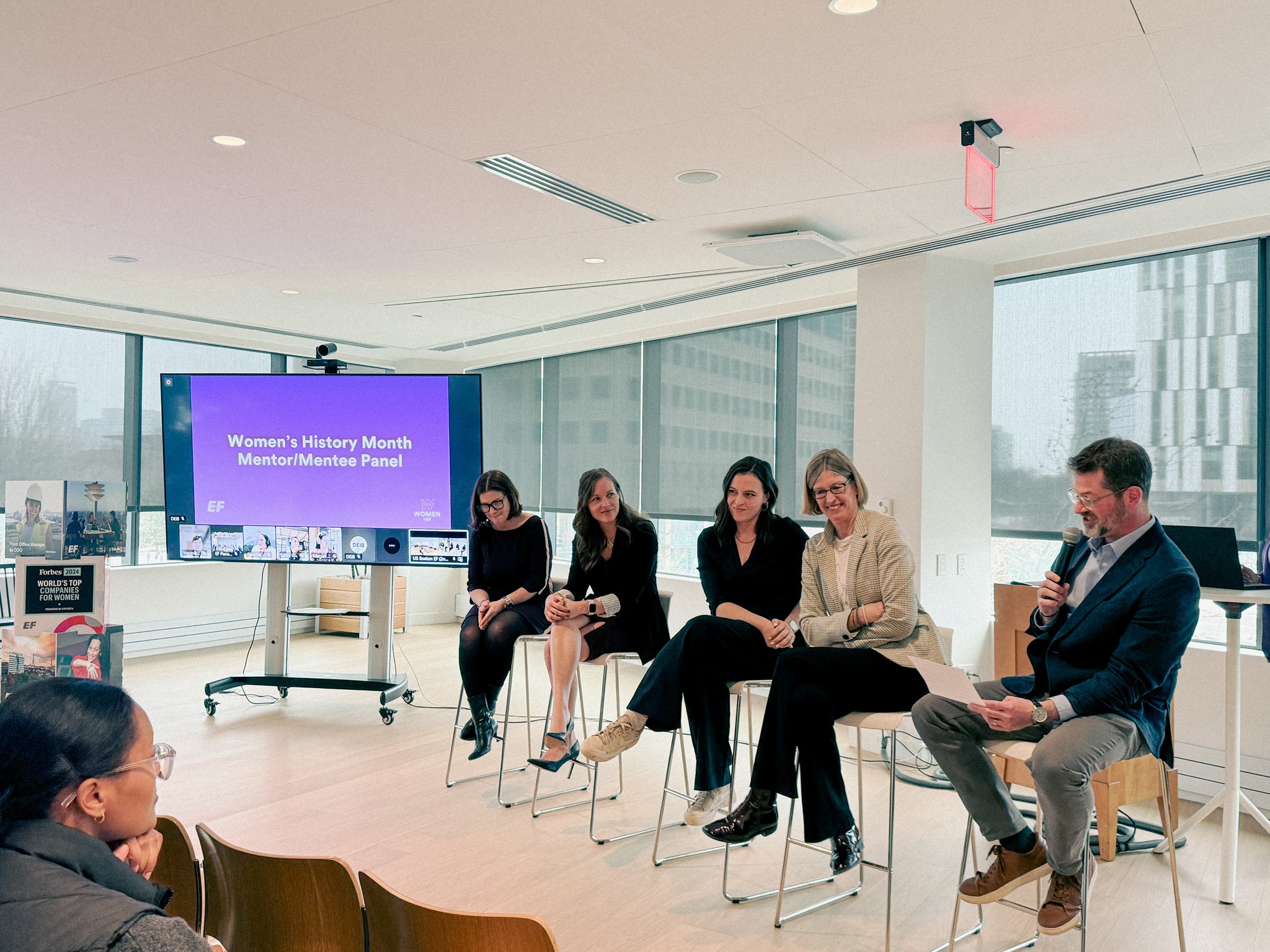
For International Women’s Day, EF hosted a panel on mentorship moderated by President of EF Ultimate Break, Shane Steffens.
The panel featured Kate Berseth, Executive Vice President of EF Educational Tours, and three women she has mentored in different parts of their EF journeys:
- Erin Subedi, Executive Vice President of EF Explore America
- Tanya Budler, Director of Recruitment
- Liz Alexander, Senior Director of Business Operations for EF Educational Tours
Their conversation is a look into how mentorship really works inside EF. Read parts of the Q&A below.
Can you talk about the various ways that mentorship can be shaped?
Kate: One secret part of mentorship is that I probably get more out of a mentor-mentee relationship than the mentee. I learn so much not only about them, but about myself and about ways I want to grow. Everyone also thinks formally when they think about mentorship, but mentorship exists everywhere at EF. It can happen in the elevator ride. There are so many informal moments where you are both giving and getting, and that comes from an open culture that loves to give feedback and loves to help people grow.
Tanya: Mentorship is that person who is opening doors for you, giving you more conversations and looking out for you. The number of times people gave me feedback because my mentor knew I needed it—that is the power of mentorship. It’s not one person who answers everything. It’s the person that is going to invest and connect those moments of feedback.
What assumptions did you have about mentorship early in your career that changed over time?
Erin: I used to think of mentorship as giving advice. I have come to understand that it is a reciprocal conversation. Mentorship is about helping folks self discover and navigate whatever is going on in their career.
Liz: It’s easy to think it needs to be defined because you see these mentorship–mentee programs. But outside of my actual managers, I don’t think I’ve ever had a defined mentorship relationship. The idea of asking “Will you be my mentor” is a little cringey to me. It’s like making friends. You don’t say, “And now that I know you, will you be my friend?” You go in with intention. What am I looking to learn, how am I looking to grow, who can give that to me, and what am I bringing of myself to the conversation? It’s, “I’d love to grab you for 30 minutes because I have a problem I’m trying to work through and I could use help.”
Was there a moment when feedback from a mentor challenged you, but also became a turning point in your career?
Tanya: All the time. I come from a family of farmers and no one was in the corporate world, so I was already starting from a different place. It was continual small feedback every single day. It shaped me, not into someone totally different, but into the better version of myself.
Liz: At one point in my career, I was trying to figure out how to manage my time better. There were so many things I wanted to do and I was in too many meetings. My manager at the time said, “You have to figure out how to scale yourself. You’re never going to grow if you can’t move beyond the things you’re doing today, and you also have to teach other people how to do that.” I thought my value was being able to do that thing well. It was hard, but he was right. It changed how I think about my value and my role, and I knew he gave that feedback because he cared about my development.
Erin: A woman on my team once gave me feedback and at that point in my career I tended to be defensive around personal feedback. She started by explaining what happened and I felt myself getting defensive, but she closed by saying, ‘And this is how it made me feel.’ That was a pivotal turning moment. Now when I receive feedback I ask, ‘Tell me how it made you feel,’ and when I give feedback I am clear and direct about that so we can support each other in a more powerful way.
What does it mean to mentor with intention—not just advice, but sponsorship and visibility?
Kate: For the people I am mentoring I think "How are they doing? How are people seeing them? How are people feeling when they interact with them? What does that mean for what I provide?" My style is to think about who I am going to connect them with and how I am helping them build the village that will help them along the way. At EF we don’t expect you to be great at everything. We expect you to understand what your interests and passion are so we can help you grow and connect you with people who can help you in those areas.
Liz: As a mentee, it makes it hard if you show up and expect someone to just grow you. What are you looking for and how are you looking to grow? It is much easier to engage with you on a specific topic instead of trying to answer “Can you give me feedback?” or “I want to become a Director tell me how to do that?”
Tanya: There is a difference between validation and feedback. It is not “Did I do OK on that?” It is “How would you have approached this situation?” That moves the conversation from validation to action.
Because you all worked with Kate, were you aware of the intentionality as it was happening, or did that become clear later?
Erin: I was not as clear on it then as I am now. Over the last two decades I have seen Kate propel careers of so many women. You cannot do that without process, systems, and intentionality. It is sponsorship, connection, trust, the ability to be vulnerable, and someone to celebrate with when things go well.
Liz: There are things I got from Kate that I am not sure she knows she gave me. When you are a mentor, you’re always mentoring. People notice what you do, what you say, how you act, and what matters to you.
Tanya: I had a high bar for what it means to be a mentor from watching Kate. I left EF and realized how special it is to have someone see you as a full person here. EF has a very high quantity of very strong mentors.
Kate: Yes, I believe very strongly for advocating for the people I believe in. You should be intentional on who you are advocating for. Make time for it. Think about it. It will make a difference in the lives of those you advocate for.
How did your mentor help you see your potential before you fully saw it yourself?
Tanya: A good mentor is not trying to make you into a mini-them. They see something in you and then grow and nurture that. When I came to my first interview at EF, I was a pretty unpolished kid and Kate just met me right there. My skirt had ripped walking from the train. I got some safety pins at the front desk and decided to own it. And based on the way she reacted to me, I have never felt so seen. Years later, when I called her for advice, she saw something in me for the role I am in now that I would never have picked for myself. You have to be very vulnerable as a mentee for this to work.
Erin: Early in my career I spoke too casually. One of my mentors pulled me aside and said, “The way you are saying what you are saying is getting in the way of what you are saying.” I have never forgotten that. It was quick and direct, and it changed something in me.
Liz: They held the bar higher. People rise to expectations if they are there. I always know that Kate never has any doubt that I can do something she thinks I can do. There is no question. I try to pay that forward by giving people opportunities to rise.
What advice would you give to people who hesitate to ask for mentorship?
Kate: You have to be intentional. You have to be brave enough to do the things that will help you grow. Choose the environment and culture you want to grow in.
Tanya: Brené Brown talks about choosing the great adventure of being brave and afraid at the exact same time. If you are a little terrified, then it is worth it.
Liz: If you think a senior person will not have time, remember mentorship is important for mentors as well. It helps us learn and grow and it helps the business. If we grow the talent in this organization, it is better for all of us.
Erin: This process is fluid all the time, so you have to be present, self-aware, and grounded, and that can be tiring. Figure out what your resilience rituals are every day. Do what you need to do to show up as your best self.
Tell us about a time you had to be vulnerable in your role. How has that helped you?
Liz: I had to be vulnerable many times at EF, sometimes because I chose to be and sometimes because I was forced to be. Vulnerability is core to growth. If you cannot be vulnerable about the things you are not good at or the things you are struggling with, it is hard to do things differently. EF leaders respond really well to vulnerability because it signals that someone is prepared to grow and learn.
Tanya: Another mentor helped me realize there were times when I should not be leading. I was open about what was going on in my life and she helped me see I did not need to take ownership of some things because I was not capable of doing them well at that time. If you share your personal life, a mentor is able to help you be who you need to be in that moment. Sometimes it is your turn to follow, and you can come back when you are ready.
If mentorship is about ‘give to gain,’ what is one thing you hope every person leaves ready to give—or ask for?
Liz: Every person is qualified to be a mentor to someone about something.
Erin: Understand that we don’t want perfect people at EF. There is no such thing. Know what you are uniquely great at and what your superpower is, and own what holds you back. That’s how we grow together.
Tanya: There are many ways to give. Sometimes it is time and going on a walk. Sometimes it is a connection. Sometimes it is a hug. Think creatively about what giving means.
Kate: Think about how you are going to reach out in the EF community or beyond. Advocate for someone, make a connection, and be intentional about it. For mentees, be vulnerable about something you are not good at so we can match you with the right people.